Filed Under Science & Technology
Kodak Junior Six-20
Dublin Core
Title
Kodak Junior Six-20
Subject
Camera, Photography, Art and Design, Art Education, Art History, Mechanical Engineering, Industrial Engineering Technology, Mechanical Engineering Technology
Description
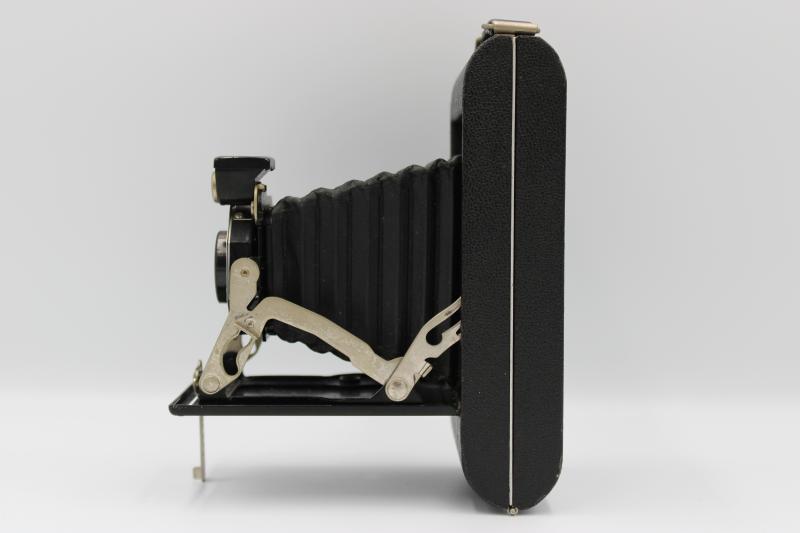
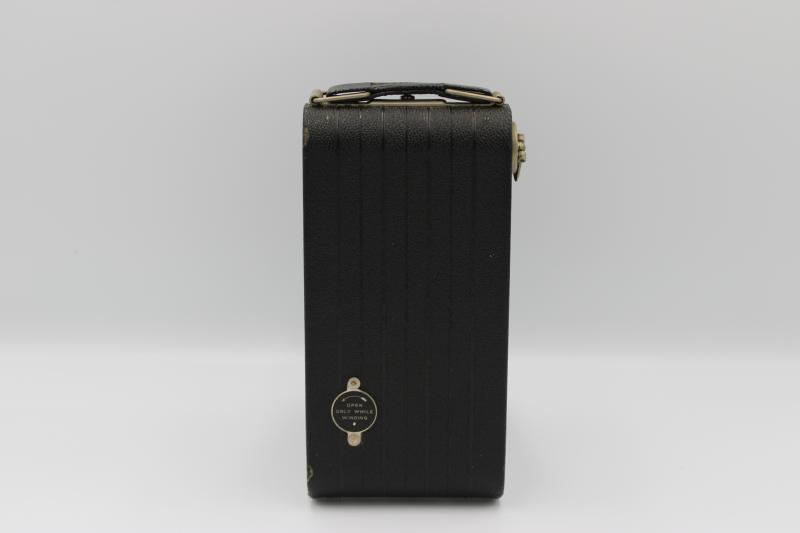
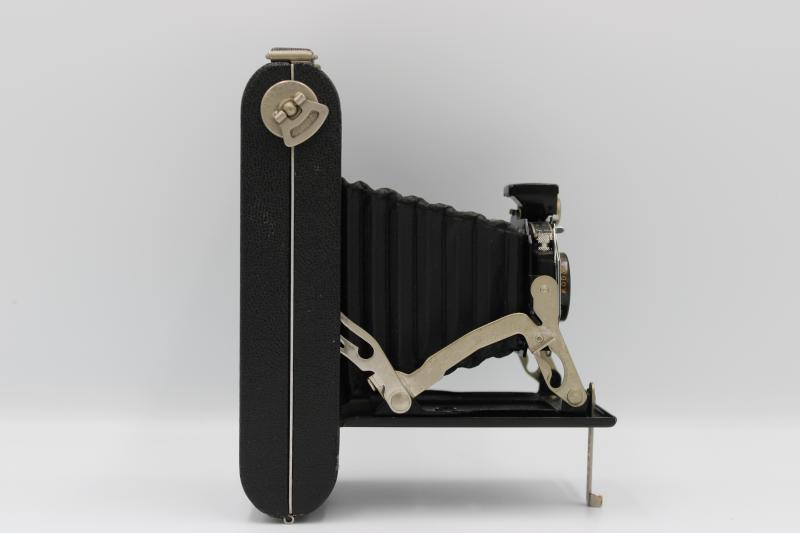
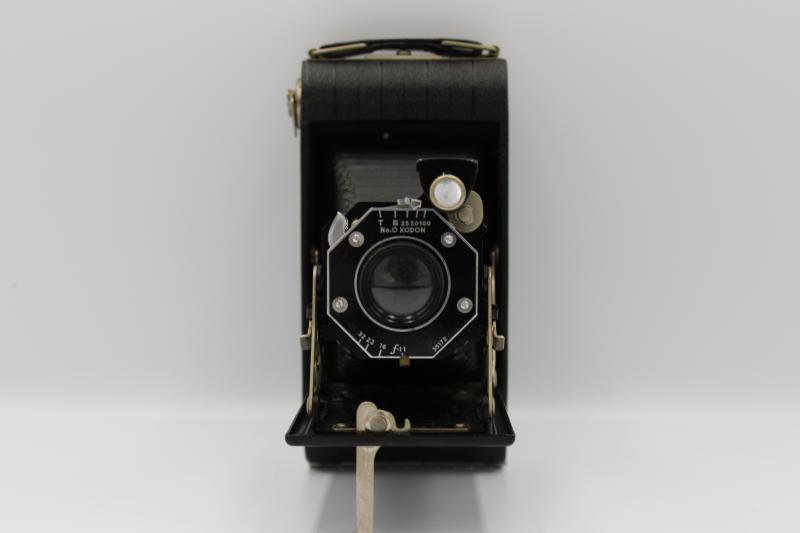
The Kodak Junior Six-20 is a folding film camera estimated to have been manufactured in the 1930s. To operate it, users need to use a lever that allows the lens to protrude into its taking position. Looking closely at the lens, one will find the text "No.0 KODON," referencing the specific shutter mechanism Kodak produced during that era. Furthermore, the camera features a small, rotating viewfinder located directly on top of the lens housing. For film loading, a handle is situated on the side; by lifting this handle, users can access the button that opens the camera body to install a new roll.
Designed for the serious amateur in the 1930s, the Kodak Junior Six-20 offered manual controls and a high-quality medium format experience, without the need for expensive professional studio equipment.
Regarding the internal mechanics, the Kodon Shutter is one of several proprietary names Kodak assigned to the shutters used in its folding camera line. This specific shutter usually offers a reliable, though simplified, range of speeds. Typically, it provides the photographer with settings of 1/25, 1/50, and 1/100 seconds, which were standard for capturing everyday scenes during that period.
ID: The overall color of Kodak Junior Six-20 is black, and some of the metal connection parts are left with the color of the metal. When the Camera is folded, on the front side of it, there is a rectangular part in the middle for the lens to move out. Also, on the side of the rectangular part, there is a metal lever for opening the camera. When the Camera is opened, the lever works as the camera stand. The lens of the camera is an octagonal shape. Behind the lens, coated fabric protects the parts that can move the lens forward.
Physical Dimensions: 6x3x1.25 inches
Designed for the serious amateur in the 1930s, the Kodak Junior Six-20 offered manual controls and a high-quality medium format experience, without the need for expensive professional studio equipment.
Regarding the internal mechanics, the Kodon Shutter is one of several proprietary names Kodak assigned to the shutters used in its folding camera line. This specific shutter usually offers a reliable, though simplified, range of speeds. Typically, it provides the photographer with settings of 1/25, 1/50, and 1/100 seconds, which were standard for capturing everyday scenes during that period.
ID: The overall color of Kodak Junior Six-20 is black, and some of the metal connection parts are left with the color of the metal. When the Camera is folded, on the front side of it, there is a rectangular part in the middle for the lens to move out. Also, on the side of the rectangular part, there is a metal lever for opening the camera. When the Camera is opened, the lever works as the camera stand. The lens of the camera is an octagonal shape. Behind the lens, coated fabric protects the parts that can move the lens forward.
Physical Dimensions: 6x3x1.25 inches
Creator
Kodak
Source
Personal Collection
Date
1933-1940
Contributor
Daniel Lee
Rights
This material is subject to copyright law and is made available for private study, scholarship, and research purposes only.
Relation
20 roll film and the history of the folding pocket cameraa
Format
JPG
Language
English
Type
Physical Object
Identifier
Serial No.55172 (stamped on the shutter assembly)