Filed Under Art & Design
Baro't Saya
Dublin Core
Title
Baro't Saya
Subject
Gender & Women’s Studies, Fashion, Filipino Culture
Description
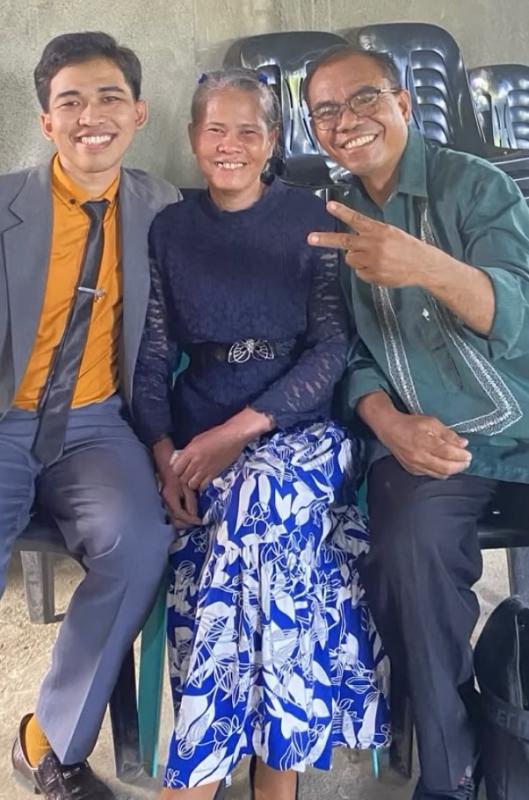
This is a photo of a Filipina family friend wearing a more contemporary version of the national dress of The Philippines known as the baro't saya. A version of the baro't saya existed before Spanish colonization first started in the Philippines in 1565, being altered and evolved by Spanish religious ideals and designs over the following 300 years. Only mainly wealthier mestiza women wore the nicer baro't saya depicted here. The quality of the dress that a woman would wear, if she could afford one, was used to show her social class and modesty during the times of Spanish colonization in The Philippines.
ID: An older Filipino woman wearing the baro't saya (blouse and skirt), the traditional Filipino women’s attire and dress that evolved during the Spanish colonial period as a blend of Indigenous Filipino clothing and Spanish influences. It consists of a lightweight baro (blouse) paired with a long saya (skirt). It is also sometimes accompanied by a pañuelo (shoulder kerchief) and a tapis (overskirt).
Physical dimensions: Size varies by wearer.
ID: An older Filipino woman wearing the baro't saya (blouse and skirt), the traditional Filipino women’s attire and dress that evolved during the Spanish colonial period as a blend of Indigenous Filipino clothing and Spanish influences. It consists of a lightweight baro (blouse) paired with a long saya (skirt). It is also sometimes accompanied by a pañuelo (shoulder kerchief) and a tapis (overskirt).
Physical dimensions: Size varies by wearer.
Creator
Unknown (Filipino)
Source
Riza Pagunsan Deguit
Date
June 2025
Contributor
Natalie Prosceno
Rights
This material is subject to copyright law and is made available for private study, scholarship, and research purposes only.
Format
JPG
Language
Tagalog
Type
Still Image
Still Image Item Type Metadata
Original Format
Photograph
Images